
Analysis · NBFC · UGRO Capital
UGRO Capital is Rebuilding both sides of it’s Balance Sheet
The ₹380 crore FMO NCD is the latest piece of a broader reset: higher-yield Emerging Market LAP and embedded merchant finance on the asset side, longer-tenor institutional funding on the liability side, and less dependence on transaction-led earnings. The next test is whether the new economics survive seasoning.
On 16 September, UGRO Capital announced a ₹380 crore five-year NCD fully subscribed by FMO, the Dutch development finance institution. In isolation, it is another borrowing transaction. Set against what UGRO has done to its loan book, income mix and cost base over the past seven months, it fits a larger story: UGRO is trying to become a different kind of lender.
It is FMO’s third investment in UGRO in under three years, after ₹250 crore in December 2023 and ₹260 crore in February 2025, taking cumulative commitment to roughly ₹890 crore. UGRO says it has now raised more than ₹1,300 crore from development-finance and impact-focused lenders.
The company is withdrawing from lower-yield intermediated lending and concentrating new origination in two businesses — Emerging Market secured LAP and Embedded Merchant Finance — while cutting reliance on co-lending and direct-assignment income, resetting the cost base built for the old model, and pushing recurring interest income to the centre of reported profitability.
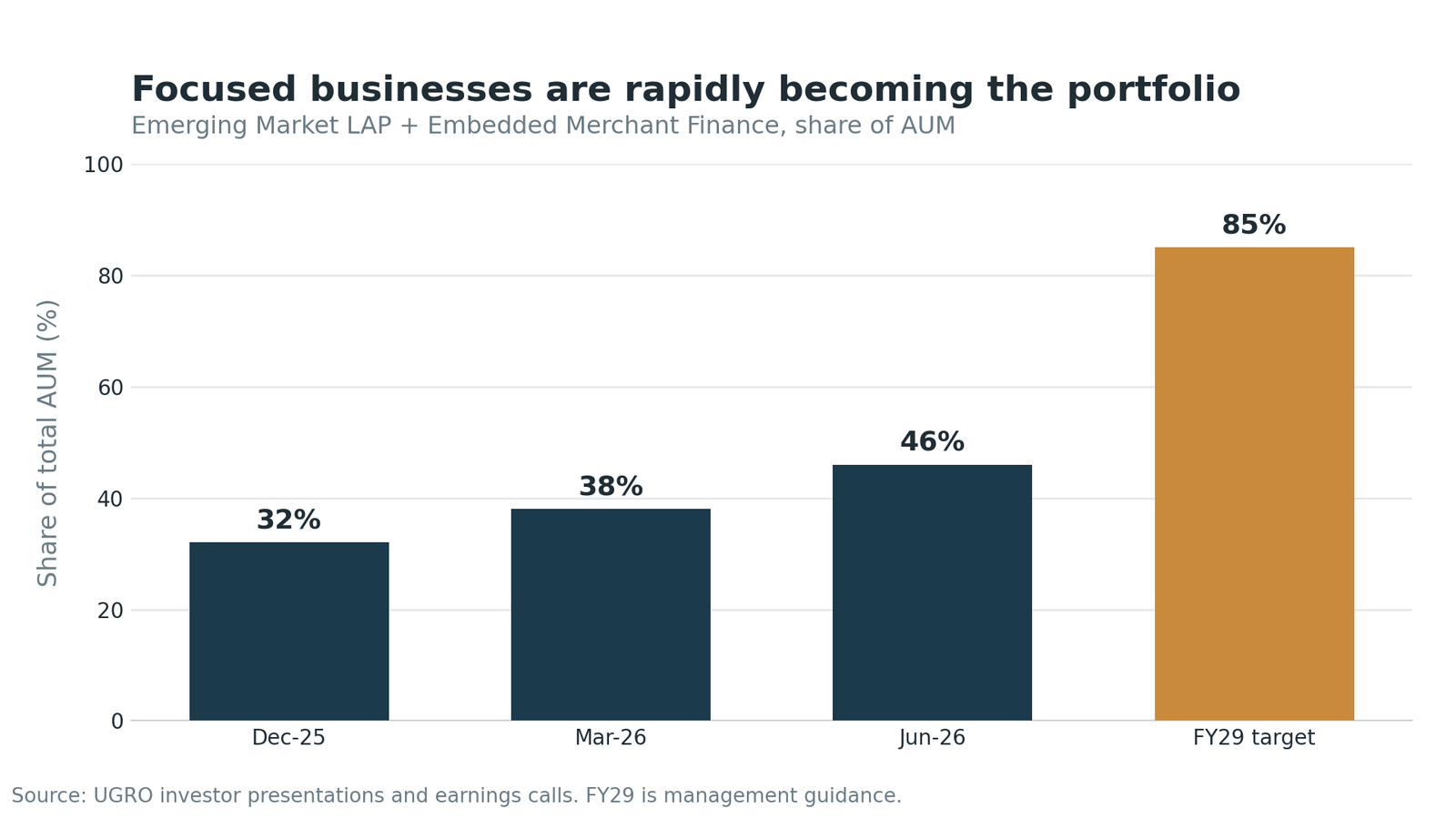
Management says the two focus businesses were 32% of AUM in December 2025, 38% by March 2026 and 46% by June, with an FY29 ambition of 85%.
Figure 01
Focused businesses are rapidly becoming the portfolio
Source: UGRO investor presentations and earnings calls. FY29 is management guidance.
The easy question is whether this produces a higher-yield portfolio. It should.
The harder one is whether higher yield, different credit behaviour, lower operating cost and a changed funding architecture combine into better-quality returns.
The AUM number understates how much is changing underneath it
UGRO ended June 2026 with consolidated AUM of about ₹15,013 crore — still 24% higher year-on-year, but below the ₹15,334 crore of March 2026.
Net disbursement, meanwhile, reached ₹2,551 crore in Q1 FY27, up 59% year-on-year.
New origination is accelerating while an older part of the book runs down, and management says that is deliberate: faster reduction of the Prime/intermediated portfolio moderates near-term AUM growth while accelerating the shift toward directly originated, higher-yield business.
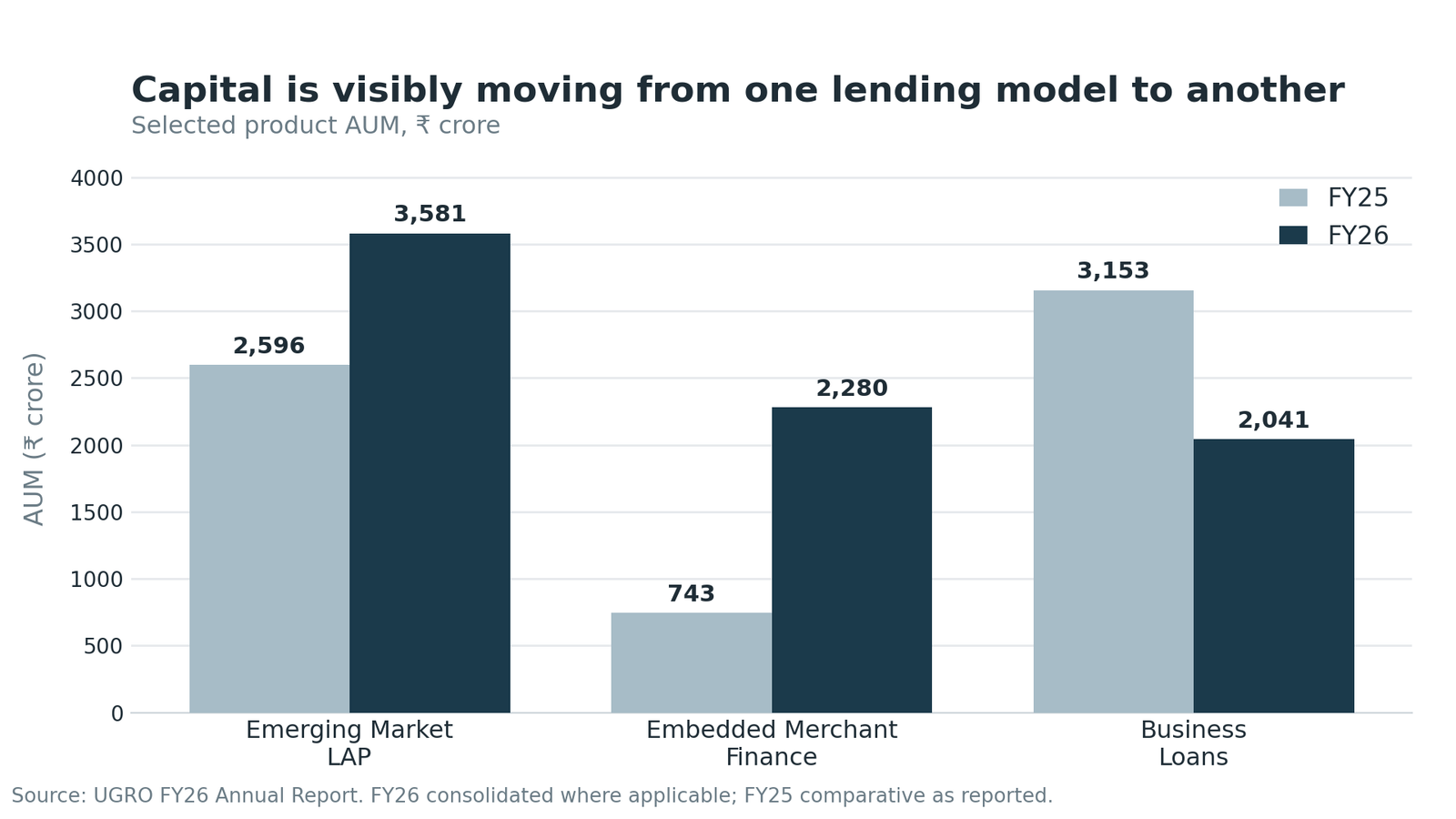
The product reallocation makes it concrete. Between FY25 and FY26, Emerging Market LAP rose from ₹2,596 crore to ₹3,581 crore and Embedded Merchant Finance more than tripled, from ₹743 crore to ₹2,280 crore, while Business Loans fell from ₹3,153 crore to ₹2,041 crore.
Figure 02
Capital is visibly moving from one lending model to another
Source: UGRO FY26 Annual Report. FY26 consolidated where applicable; FY25 comparative as reported.
The two growth engines carry very different credit economics
Treating both as simply “higher-yield” misses the point: their risk mechanics differ.
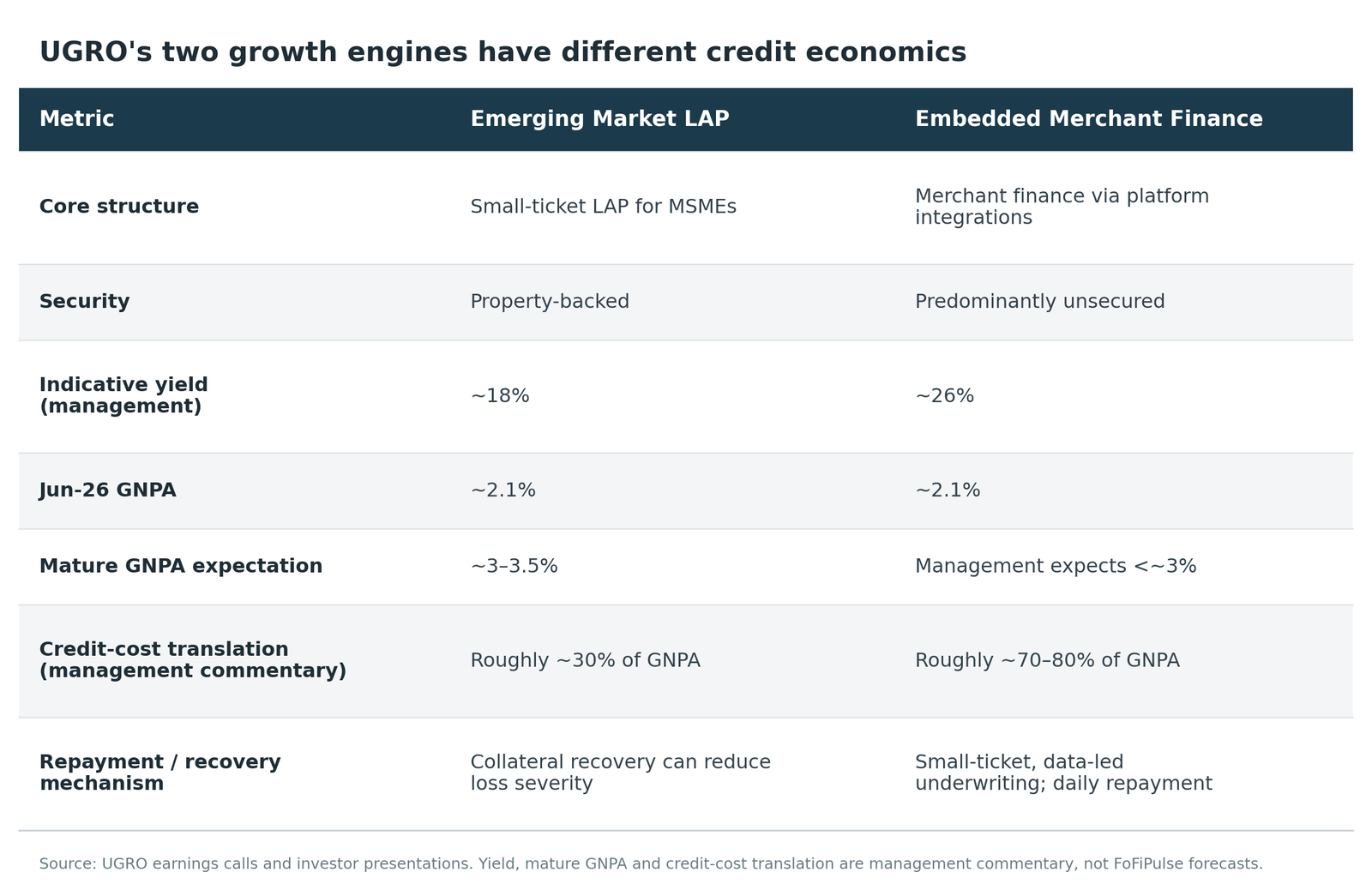
Table 01
UGRO’s two growth engines have different credit economics
Source: UGRO earnings calls and investor presentations. Yield, mature GNPA and credit-cost translation are management commentary, not FoFiPulse forecasts.
Management has said Emerging Market LAP can run at a higher GNPA without proportionately higher credit losses, because the loans are secured and recovery continues after delinquency. It puts secured credit cost at roughly 30% of GNPA.
Embedded Finance is different: credit cost there runs much closer to GNPA, around 70–80%.
On the March 2026 call, management described Embedded Finance as roughly ₹1 lakh average-ticket lending, underwritten on payment flows, GRO Score and platform integration with daily repayment, at a roughly 26% yield versus 18–19% on the old business-loan model.
So a 3% GNPA secured book and a 3% GNPA unsecured book do not produce the same economic loss — and a higher default frequency need not make a product inferior if yield, recovery and cost still line up.
After credit cost, the engines are further apart — and less symmetric
Management’s own numbers allow a step it did not take: converting each yield into a yield net of credit cost.
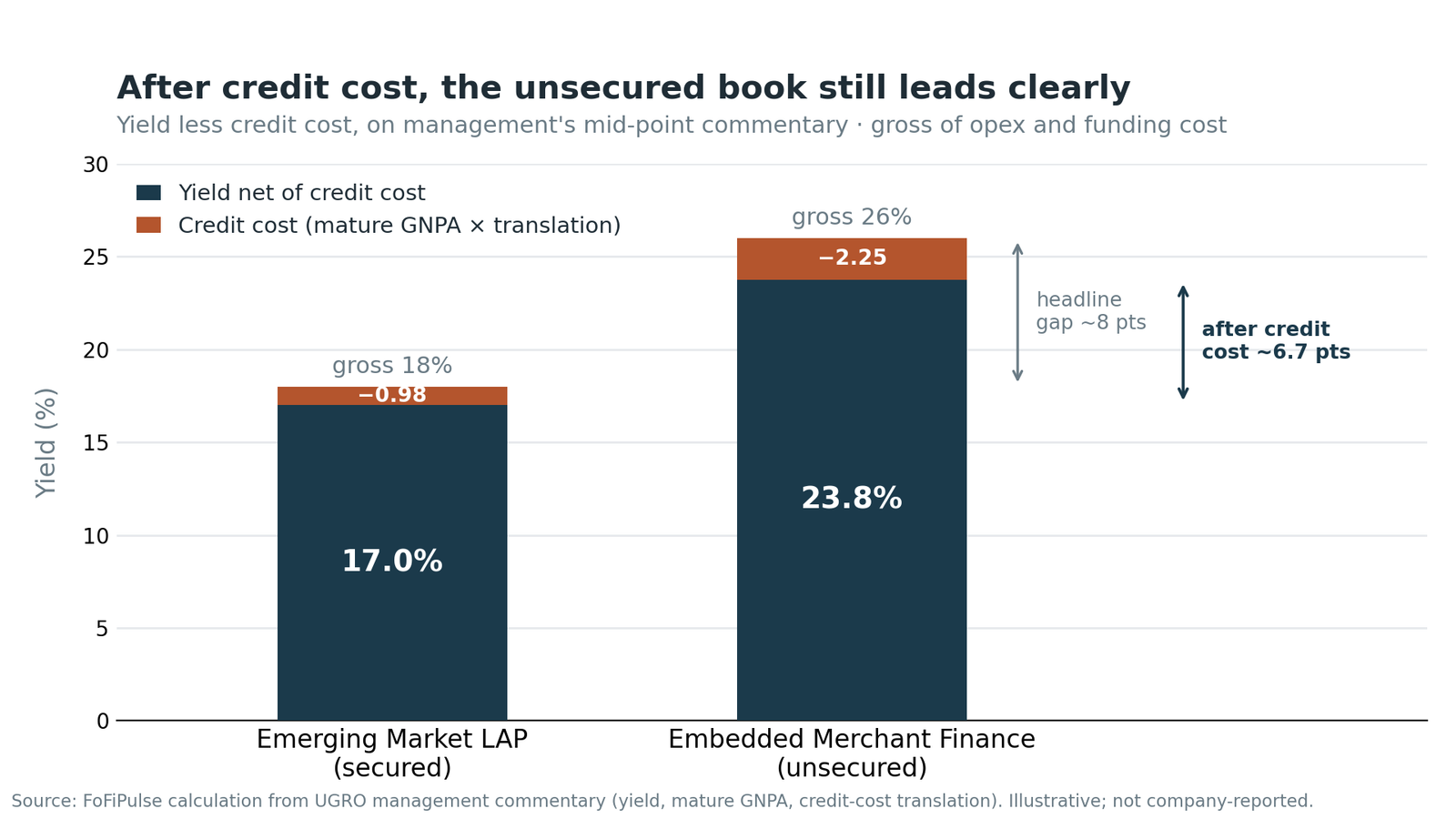
On the mid-points it has described, Emerging Market LAP earns about 18%, seasons toward a mature GNPA near 3.25%, and turns roughly 30% of that into credit cost — about 1.0 percentage point — leaving a credit-adjusted yield near 17%.
Embedded Finance earns about 26%, is expected to hold mature GNPA below roughly 3%, but converts 70–80% of GNPA into credit cost — about 2.25 percentage points at a 3% GNPA and 75% translation — leaving a credit-adjusted yield near 23.8%.
The headline yield gap of about eight percentage points therefore narrows only to around 6.7 points after credit cost.
The unsecured book’s higher loss intensity consumes barely more than a point of its yield advantage.
Figure 04
After credit cost, the unsecured book still leads clearly
Source: FoFiPulse calculation from UGRO management commentary on yield, mature GNPA and credit-cost translation. Illustrative; gross of operating cost and funding cost; not company-reported.
The catch is sensitivity, not the base case.
Because roughly three-quarters of any GNPA increase flows straight to credit cost on the unsecured book, against under a third on the secured one, Embedded gives back its economics about two and a half times faster for every point that mature GNPA exceeds expectation.
The collateral on Emerging Market LAP does the opposite: recovery continues after delinquency, so the book bends rather than breaks when a cohort disappoints.
That matters because neither book is fully seasoned.
Between March and June 2026, Emerging Market LAP GNPA moved from roughly 1.2% to 2.1% and Embedded Finance from about 1.7% to 2.1%. Management calls both within the expected seasoning path.
Emerging Market LAP is expected to settle around 3–3.5% as the average book crosses roughly 18 months; Embedded, with average tenure of only around 12–13 months, is further through its cycle and expected to hold below roughly 3%.
Management itself noted on the Q1 FY27 call that strong book growth can make GNPA look lower while a portfolio is still seasoning. The June ratios are therefore neither proof the strategy is weakening nor the mature-state outcome.
Two limits matter in interpreting this arithmetic. It uses management mid-point commentary rather than disclosed loss data, and it is gross of operating cost and cost of funds.
A ₹1 lakh, daily-repayment, data-underwritten loan does not carry the same servicing cost as a branch-originated secured LAP. A credit-adjusted yield gap is therefore not the same thing as a credit-adjusted return gap.
It is a credit-economics lens, not a full profitability verdict.
The more unusual reset is inside ROA
The most interesting move may not be on the asset side at all — it is UGRO’s changing definition of desirable profitability.
The company had discussed an ROA ambition around 4%, but now acknowledges that framework assumed a large contribution from co-lending and direct-assignment income.
Its February update said the old model recognised more transaction-linked income upfront, while the new one leans on annuity interest income, cash generation and closer alignment between profit and net-worth accretion.
On the call, management went further: more than half of the earlier ROA contribution could be traced to asset downselling, and that contribution should fall substantially.
One is higher near-term accounting return. The other is potentially more repeatable, cash-generative and capable of compounding net worth without repeated equity issuance.
UGRO is betting on the latter.
By Q1 FY27 it reported ROA of 2.8% and ROE of 9.2% while co-lending and direct-assignment income had already fallen materially. It is therefore trying to hold profitability while deliberately shrinking an income stream that used to support it.
Cost reduction is doing much of the bridge
The transition would be harder if UGRO still carried its expansion-phase cost base. It does not.
The combined UGRO-Profectus operating-cost base was about ₹750 crore before the reset. Initial FY27 guidance was for a fall toward ₹490 crore-plus.
By Q1 FY27 quarterly opex was already around ₹118.5 crore — roughly ₹474 crore annualised — with management calling the major cost reset substantially complete.
The Emerging Market branch network is central.
UGRO spent three years building more than 300 branches. That network is now largely complete and the focus has shifted from footprint expansion to productivity.
Q1 FY27 disbursement from the vertical was ₹592 crore at blended branch productivity of about ₹0.62 crore per month, against a target near ₹0.80 crore as branches mature.
That is the operating-leverage test embedded in the reset.
The ₹380 crore FMO deal completes the other half of the picture
Which brings us back to the financing.
The new transaction is ₹380 crore of senior secured NCDs with a five-year tenor, following ₹250 crore in December 2023 and ₹260 crore in February 2025.
Figure 03
FMO has progressively increased its exposure to UGRO
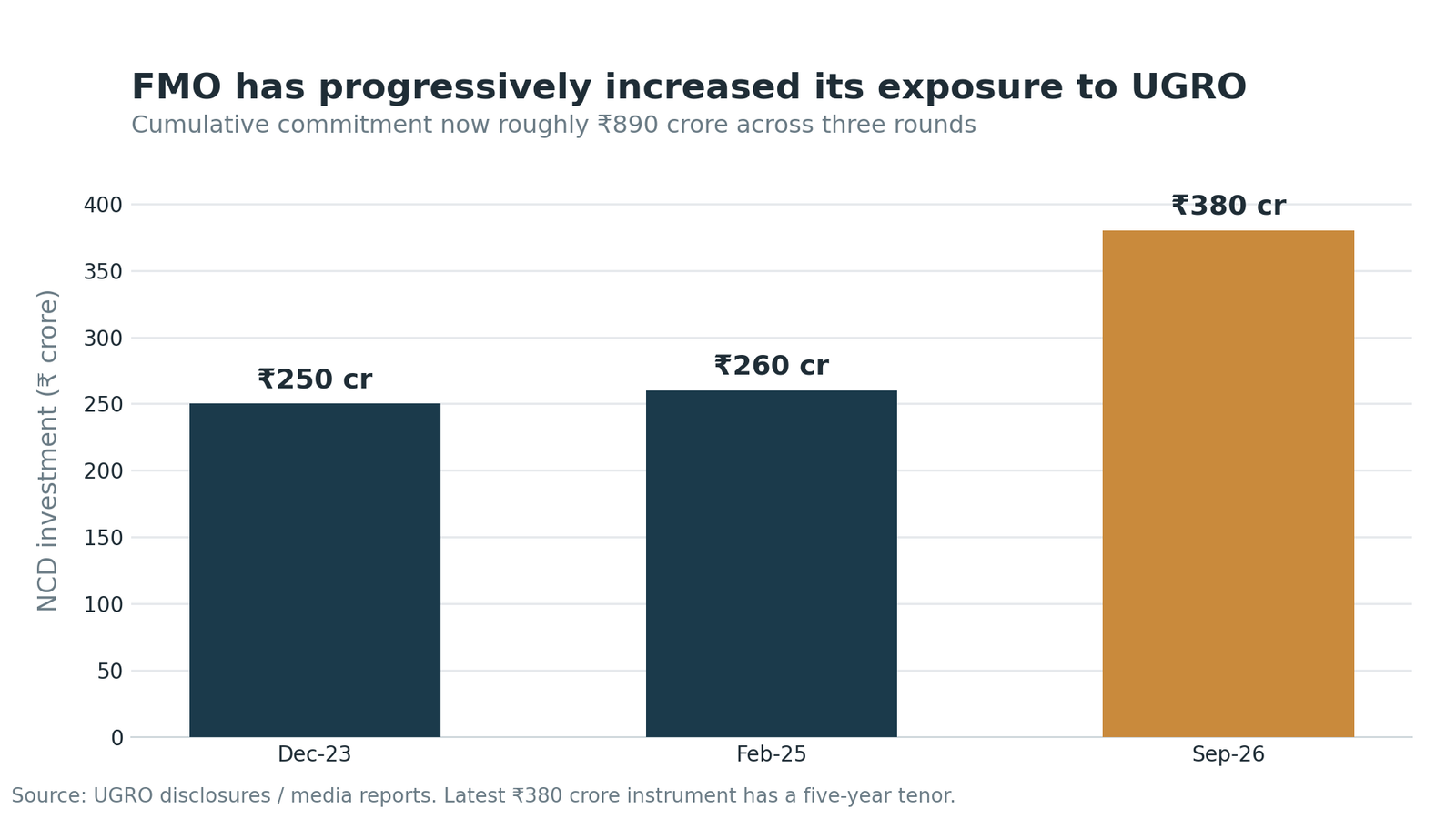
Source: UGRO disclosures and media reports. Cumulative FMO commitment is now roughly ₹890 crore. The latest ₹380 crore instrument has a five-year tenor.
The amount is not transformative against a ₹15,000 crore-plus book. The structure is the point.
A five-year institutional borrowing matches the longer-duration secured loans UGRO increasingly wants to originate, and the company frames the objective as diversifying long-tenor funding and reducing dependence on domestic bank lines.
Repeat investment matters too.
FMO has now committed three times, each larger than the last, which expands UGRO’s liability options precisely as management tries to reduce the model’s sensitivity to funding costs.
That sensitivity mattered most under the old Prime/intermediated book, which worked best only when borrowing costs were very low.
More than a portfolio-mix story
Taken together, UGRO is attempting several transitions at once: focus-business share up from 32% to 46% of AUM in six months, Prime/intermediated running down, opex reset materially lower, co-lending and direct-assignment income fading, branches moving into their productivity phase, Embedded Finance scaling, and funding diversifying across banks, co-lenders, DFIs and institutional investors.
The FMO NCD matters less as a fundraise than as one more piece of that architecture.
The upside case is clear: higher-yield assets, better use of existing infrastructure, lower cost, recurring interest income and enough internal capital to avoid fresh equity through FY29 — which UGRO states explicitly.
The risks are equally clear, and this analysis sharpens rather than softens them.
Emerging Market LAP is still seasoning toward a higher mature GNPA. Embedded Finance is unsecured and converts delinquency into loss roughly two-and-a-half times faster. Prime runoff can suppress headline AUM before the focus books are large enough to compensate. And shrinking transaction income means recurring spread and operating leverage have to replace it.
The next few quarters should therefore not be judged mainly on headline AUM.
The more useful questions are whether the 46% focused mix keeps rising, whether branch productivity closes toward target, whether Embedded Finance holds its credit-cost curve as cohorts mature, whether recurring interest income keeps replacing transaction income, and whether the new funding relationships harden into a more resilient liability profile.
Sources: UGRO Capital FY26 Annual Report; UGRO Q1 FY27 investor presentation and unaudited results; UGRO Q1 FY27 and Q3 FY26 earnings calls; UGRO strategic realignment presentation dated 7 February 2026; UGRO Q2 FY26 and Q3 FY26 press releases; Business Standard, 16 September 2026; UGRO investor relations.
Method note: Figures described as targets, expectations or credit-cost relationships are management guidance or commentary, not FoFiPulse forecasts. The risk-adjusted yield in Figure 04 is a FoFiPulse calculation applying management’s mid-point commentary: Emerging Market LAP at 18% yield, 3.25% mature GNPA and 30% credit-cost translation; Embedded Merchant Finance at 26% yield, 3.0% GNPA and 75% translation. The calculation is gross of operating cost and cost of funds and is illustrative rather than company-reported. Q3 FY26 onward includes Profectus consolidation where UGRO reports consolidated data; comparisons should be read with that scope change in mind.