
Analysis · NBFC · MAS Financial
MAS Financials 20% growth ambition is holding up. The DPD pipeline shows where the test comes next
Early stress has fallen from its FY26 peak even as originations accelerated. But the stock of loans already more than 90 days past due continues to rise. Seasoning and resolution are now the more important tests.
MAS Financial’s headline asset-quality numbers barely moved over the past year. Underneath them, however, the front and back of the delinquency pipeline have moved in very different directions.
Standalone AUM rose 21.1% year-on-year to ₹15,147 crore by June 2026, while Gross Stage 3 moved only from 2.49% to 2.58% and Net Stage 3 from 1.63% to 1.70%. On the surface, that looks like a lender growing above 20% without a material deterioration in reported asset quality.
The delinquency buckets underneath that headline tell a more useful story. Loans between 1 and 90 days past due have fallen sharply from their FY26 peak. Loans already beyond 90 days have not.
That divergence — rather than the blended Gross Stage 3 ratio alone — is the more interesting way to read MAS’s current credit cycle.
Early delinquency has improved
MAS reports its standalone portfolio across five delinquency buckets: 1–30, 31–60, 61–90, 91–120 and more than 120 days past due. Combining the first three gives us a useful view of loans showing stress but not yet beyond 90 DPD.
That 1–90 DPD pool stood at 4.12% of AUM in June 2025, deteriorated sharply to 4.92% in September 2025, and then improved in each of the next three quarters:
The improvement is stronger than the percentages alone suggest. Applying the disclosed DPD ratios to reported quarter-end AUM, the estimated stock of 1–90 DPD loans fell from roughly ₹640 crore in September 2025 to about ₹586 crore in June 2026.
AUM increased from around ₹13,000 crore to ₹15,147 crore over the same period. The early-stress pool therefore contracted by roughly 8% in rupee terms while the portfolio expanded by more than 16%.
That makes it difficult to explain the improvement purely through denominator growth. There appears to have been a real reduction in the amount of credit sitting in the early stages of delinquency.
Figure 01
Early delinquency has eased; deep delinquency has not
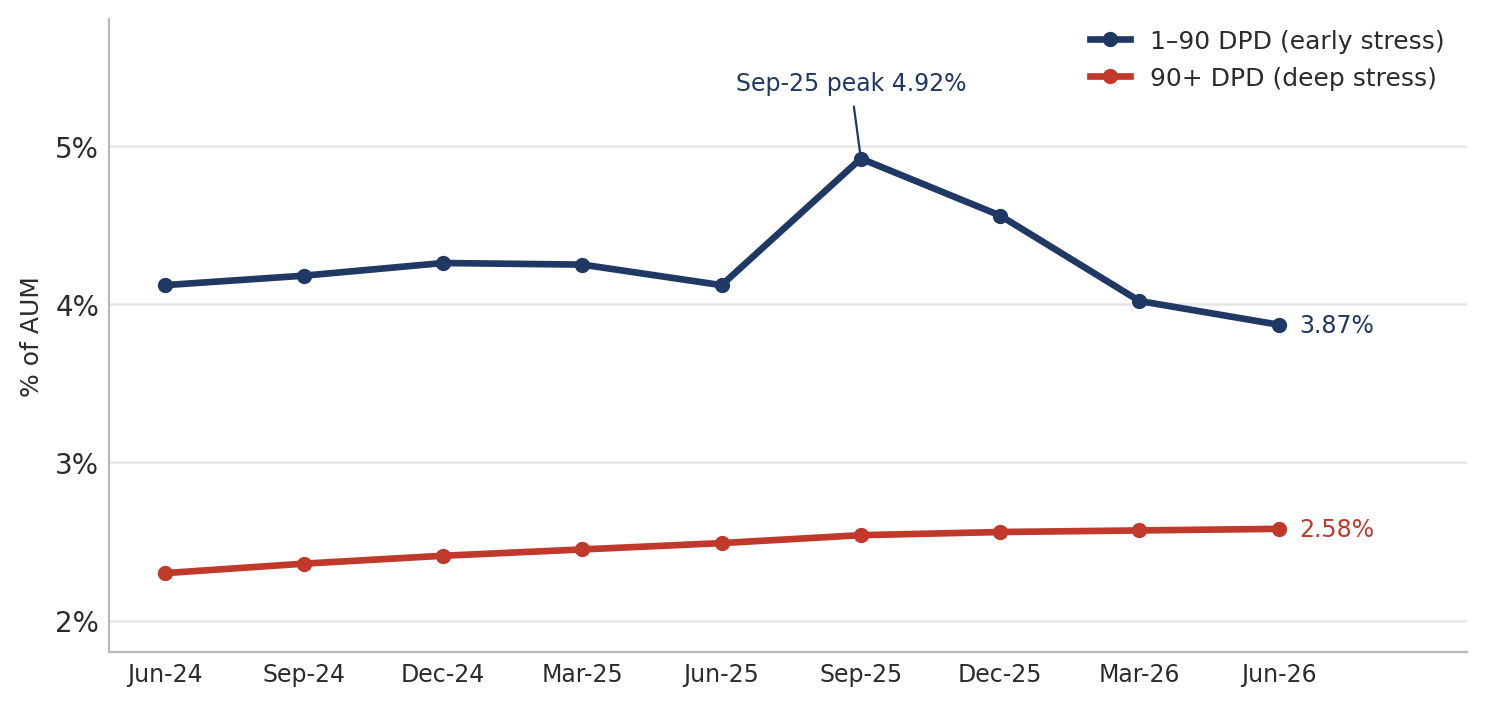
Source: MAS Financial Q1 FY27 investor presentation, p.22. 1–90 DPD combines the 1–30, 31–60 and 61–90 buckets. 90+ DPD combines 91–120 and more than 120 DPD. Derived series are FoFiPulse calculations.
Deep delinquency has not followed
The other end of the pipeline has behaved differently. Estimated 90+ DPD assets increased from approximately ₹311 crore in June 2025 to about ₹391 crore in June 2026 — an increase of roughly 26%.
Yet the corresponding ratio moved by only nine basis points, from 2.49% to 2.58%, because MAS’s AUM was expanding rapidly underneath it.
The deepest delinquency bucket is particularly worth watching. Loans more than 120 days past due increased from 1.95% of AUM in June 2025 to 2.02% in June 2026. In approximate rupee terms, that is an increase from ₹244 crore to ₹306 crore.
By comparison, the 91–120 DPD bucket was only about ₹85 crore in June 2026. Much of the late-stage stress therefore sits at the far end of the delinquency curve, where resolution is typically harder.
₹3
Approximate increase in closing 90+ DPD stock for every ₹100 of AUM added between June 2025 and June 2026.
MAS added about ₹2,642 crore of AUM between June 2025 and June 2026, alongside roughly ₹79 crore of additional 90+ DPD stock.
That ₹3 figure is not a default rate on incremental lending. The closing 90+ stock reflects ageing, cures, recoveries, write-offs, new slippages and portfolio exits. It simply illustrates what a near-flat percentage can hide when the denominator is growing quickly: the absolute amount of stressed credit can still rise materially.
Figure 02
The early and deep-stress stocks are moving apart
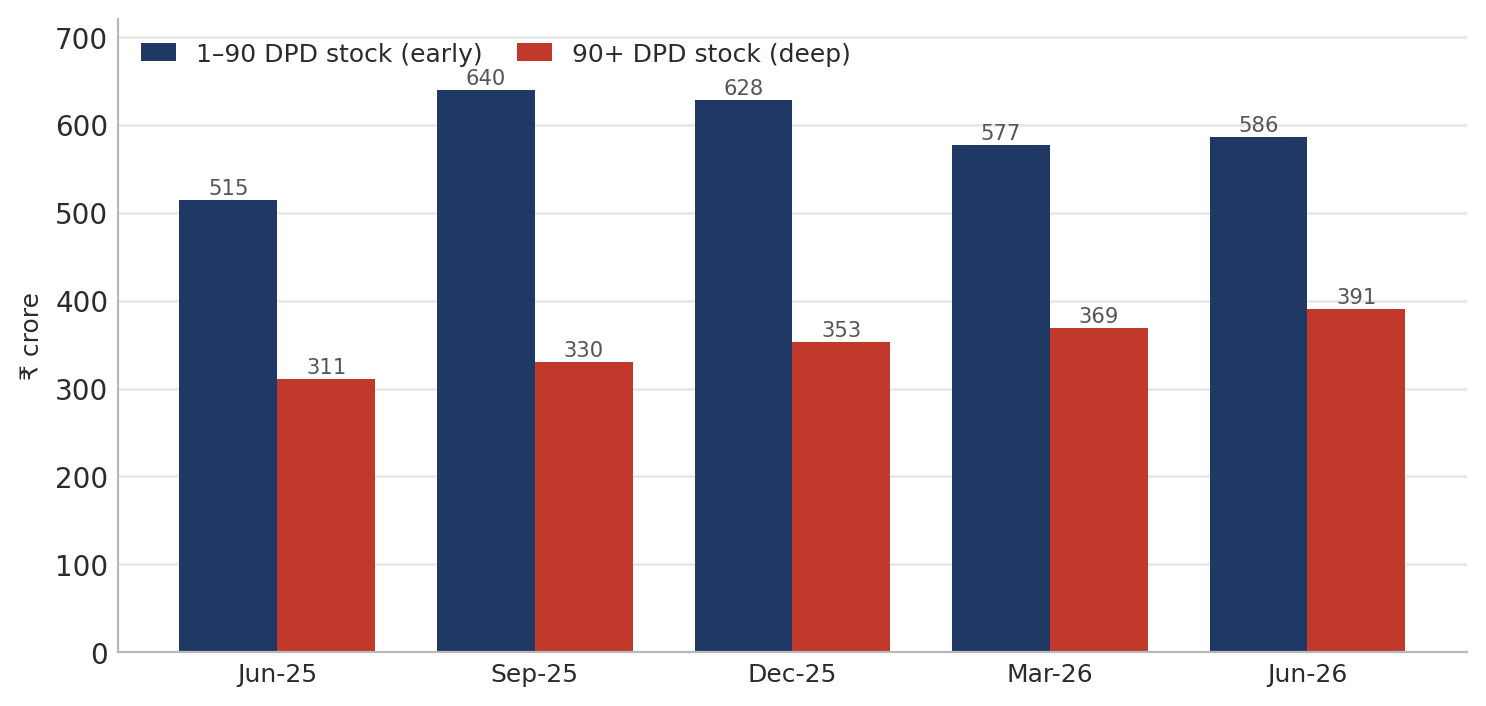
Source: MAS Financial disclosures; FoFiPulse calculations. Approximate balances are calculated using reported standalone AUM multiplied by disclosed DPD percentages and are not company-reported rupee balances unless specifically stated.
Faster origination makes seasoning the key uncertainty
MAS did not produce the improvement in early delinquency by slowing the front end of the business.
Standalone quarterly disbursement increased from about ₹3,130 crore in Q1 FY26 to ₹4,462 crore in Q1 FY27 — roughly 42.5% year-on-year. Early delinquency therefore fell while origination accelerated.
That is encouraging, but it also complicates the interpretation.
Rapidly increasing originations make the portfolio younger. Newly originated loans begin life in the zero-DPD bucket and require several repayment cycles before their underlying credit behaviour becomes visible.
A lower aggregate early-DPD ratio can therefore reflect several things at once: better underwriting, tighter borrower selection, stronger collections, improving borrower behaviour — or simply a larger share of loans that have not yet seasoned.
MAS does not publicly disclose full-book vintage curves or borrower-level transition matrices in the material used here. Quarterly DPD distributions are snapshots of different portfolios, not observations of the same accounts moving from one bucket to another. They therefore cannot be used to calculate true roll rates.
The important question for the next several quarters is not simply whether 1–90 DPD remains below 4%.
It is whether early delinquency remains contained once the recent surge in originations has had time to season.
Supporting evidence
Some of the early improvement is also the cycle
MAS’s early-DPD improvement did not occur in isolation. The SIDBI–CRIF High Mark Small Business Spotlight data showed broader improvement in small-business asset quality through March 2026.
Early delinquency at the sector level eased, which means not all of the front-end improvement visible at MAS should automatically be attributed to company-specific underwriting.
That context actually makes the deeper end of MAS’s delinquency curve more interesting. MAS’s more-than-120-day bucket continued to rise even as broader small-business stress measures were easing.
The sector and company bucket definitions do not line up exactly, so this is a directional rather than like-for-like comparison. But the distinction is useful: some of MAS’s improvement appears cyclical, while the build-up at the deep end deserves more company-specific attention.
The AUM view includes both retained and assigned loans
MAS reports credit quality on total AUM, so it is useful to separate the portfolio it retains from the loans it has assigned to banks.
By June 2026, roughly four-fifths of AUM remained on MAS’s own book, with the balance in assigned pools. The off-book share has reduced over the past two years rather than increased, meaning MAS is not relying on a rising assignment share to support the headline asset-quality ratio.
The assigned portfolio also does not appear dramatically cleaner than the retained portfolio. MAS’s disclosures put Stage 3 at roughly similar levels across the two pools.
The distinction matters more when moving from gross to net stress. Provisions are carried against MAS’s own on-book exposure, while assigned loans sit economically and accounting-wise differently after transfer. That makes the Net Stage 3 number on total AUM less directly comparable with an on-book coverage calculation.
MAS has also increased provisioning on performing Stage 1 and Stage 2 assets. That additional buffer is worth tracking alongside the movement in the deep-delinquency stock rather than reading either number in isolation.
Commercial vehicles offer one visible test of risk discipline
The aggregate portfolio also masks substantial differences between products.
During the Q3 FY26 earnings call, management disclosed product-level GNPA for December 2025. Commercial vehicles were highest at 4.14%, compared with 3.45% for salaried personal loans, 3.35% for two-wheelers, 2.80% for micro-enterprise loans and 1.49% for SME loans.
That December snapshot should not be treated as the June 2026 product position — MAS has not disclosed a comparable five-product GNPA table since then.
What happened subsequently is nevertheless useful.
By June 2026, commercial-vehicle AUM had grown only 13.3% year-on-year, from about ₹967 crore to ₹1,096 crore. That was materially below MEL at 22.8%, SME at 21.2%, salaried personal loans at 21.5% and two-wheelers at 19.2%.
On the July 2026 earnings call, an analyst explicitly highlighted a sharper increase in CV GNPA relative to other segments. Management said it had tightened its credit screen, reducing eligible demand, and was recalibrating both the product and distribution process. It indicated that it wanted another one or two quarters before pushing volumes again.
The evidence does not prove that the December GNPA number caused the subsequent slowdown.
But the sequence is consistent with deliberate risk management: the product with the highest disclosed stress was subsequently the slowest-growing major segment, while management was openly describing tighter credit filters.
Figure 03
Commercial vehicles stand apart: higher disclosed stress, slower subsequent growth
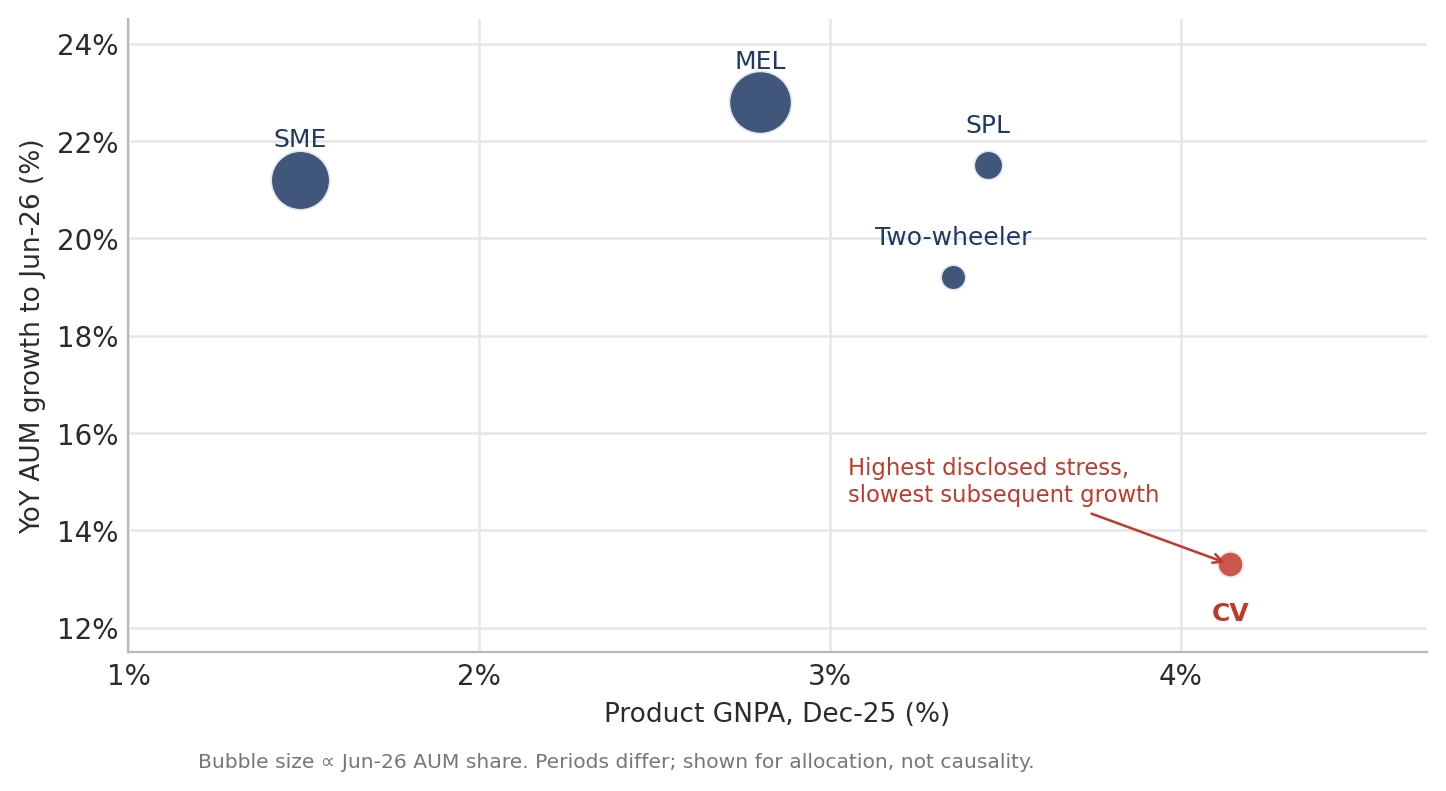
Source: MAS Financial Q3 FY26 earnings call and Q1 FY27 investor presentation. Product GNPA is the December 2025 snapshot; growth is June 2026 year-on-year. The different periods are shown to examine subsequent portfolio allocation and do not establish causality.
What comes next
The next test is not growth. It is the quality of the growth already booked.
MAS continues to operate around its 20–25% growth ambition, and the current data does not show a broad asset-quality break.
In fact, the strongest observation in the numbers is constructive: the early-delinquency stock has fallen materially from its FY26 peak even as the company continued to expand and origination accelerated.
But the credit cycle is not fully resolving either.
The 90+ stock continues to rise. More than ₹300 crore now sits beyond 120 DPD on an approximate basis. And the recent acceleration in disbursement means a growing share of the current portfolio has yet to demonstrate how it performs through seasoning.
Those two forces make the next several quarters particularly informative.
If recent cohorts season without refilling the 1–90 DPD buckets, while the 90+ stock begins to stabilise or decline through cures, recoveries and write-offs, MAS will have stronger evidence that the improvement at the front of its credit pipeline is durable.
If early delinquencies begin rising again as recent originations mature, the interpretation changes.
Commercial vehicles provide another useful marker. If MAS reaccelerates CV growth only after asset quality improves, that would reinforce the evidence that growth is being allocated selectively rather than pursued independently of risk.
Sources: MAS Financial Services Q1 FY27 investor presentation and unaudited results; Q3 FY26 and Q1 FY27 earnings calls; SIDBI–CRIF High Mark Small Business Spotlight. Figures described as approximate are FoFiPulse calculations using disclosed DPD percentages and reported AUM.
Method note: quarterly DPD buckets are portfolio snapshots and should not be interpreted as borrower-level roll rates. December 2025 is the latest five-product numerical GNPA disclosure used in this analysis.