
Analysis · Banking · Credit
India’s Lenders Are Flush With Liquidity. RBI Doesn’t Want It Turning Into a Credit Price War.
A record wave of foreign-currency deposits has transformed banking-system liquidity just as credit demand and lender risk appetite are strengthening. The question is no longer whether lenders have money to deploy — but where they deploy it, and at what price.
India’s lending environment has changed remarkably quickly.
Banks mobilised $132.98 billion through FCNR(B) deposits under the Reserve Bank of India’s special swap facility before the window closed on August 31. Including external commercial borrowings and overseas foreign-currency borrowings, total inflows reported under the facility reached $143.6 billion by September 18.
The immediate result was a surge in rupee liquidity.
Banking-system surplus liquidity climbed to a record ₹11.16 lakh crore in early September. RBI has since aggressively absorbed much of that excess through bond sales, reverse repos and foreign-exchange operations; by September 21, the surplus had fallen to around ₹4.92 lakh crore.
But the bigger story may only be beginning.
The FCNR mobilisation has fundamentally altered banks’ funding position at a time when credit demand is strengthening across several parts of the economy.
And that combination — abundant funding, improving asset quality and lenders becoming more willing to take risk — is precisely what can change the competitive dynamics of credit.
Figure 01
Banking-system surplus liquidity fell sharply after RBI absorption
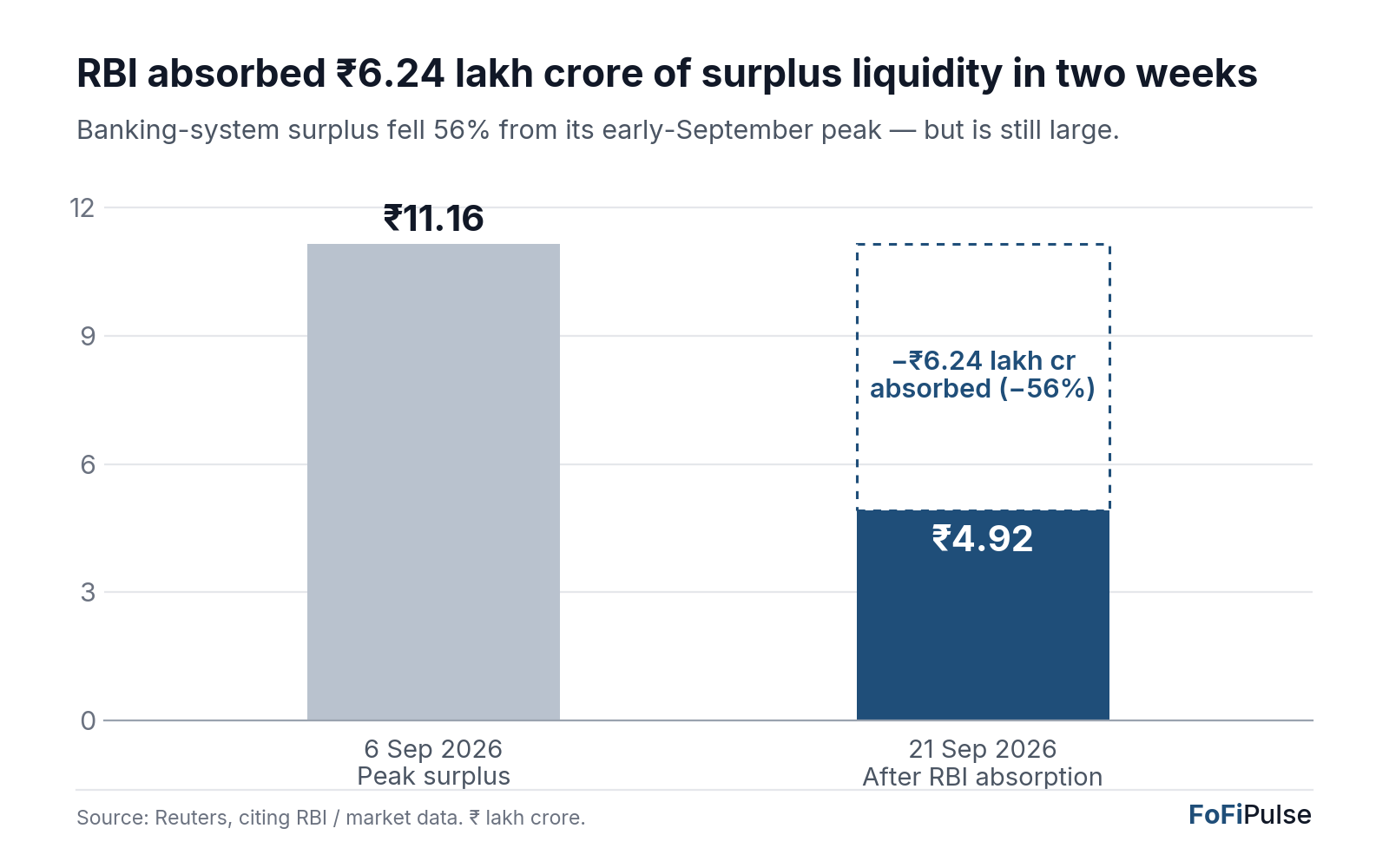
Source: Reuters, citing RBI / market data.
From a funding shortage to a deployment problem
Until recently, one of the major constraints on Indian banks was the persistent gap between credit and deposit growth.
The FCNR mobilisation has helped narrow that gap dramatically.
In the fortnight ended August 31, bank credit was growing 19.1% year-on-year, while deposit growth accelerated to 17.8%, its highest pace in years. Deposits increased by roughly ₹9.5 lakh crore during the fortnight, compared with an increase of about ₹3.8 lakh crore in credit. Part of the acceleration in headline credit growth also reflects base effects, so the 19.1% figure should not be read in isolation.
What matters is the change in the funding equation.
Banks that had spent several years competing aggressively for deposits suddenly have considerably more balance-sheet liquidity available for deployment.
SBI Research attempted to quantify the potential effect.
Using a credit multiplier of 2.5, it estimated that roughly $127 billion of FCNR(B) deposits could ultimately support around ₹25 lakh crore of additional bank credit.
That is an analytical estimate rather than a forecast that ₹25 lakh crore will actually be lent. Credit demand, capital requirements, risk appetite and RBI liquidity operations will ultimately determine how much of the funding translates into new loans.
But even directionally, the implication is significant.
The constraint is shifting from “Where do banks find funding?” towards “Where do banks deploy it?”
At the same time, lenders are becoming more willing to take risk
The change in funding conditions is arriving just as parts of the retail credit cycle appear to be accelerating again.
UBS said this week that India may be entering a new unsecured-credit growth cycle, supported by improving asset quality, ample liquidity and a more risk-on stance among lenders.
Citing CRIF data for August, UBS said personal-loan growth had accelerated to around 30% year-on-year for NBFCs and 9% for banks, with bank growth at its strongest pace in two years.
NBFC personal-loan growth, according to the report, has risen from 16% in March 2025 to 30% in August 2026.
There is another important part of that story: asset quality has improved.
UBS reported that early delinquencies in NBFC personal loans — loans in the 1–30 days-past-due bucket — had declined to 1.8% in August 2026 from 3.5% in June 2024.
That matters because improving recent-vintage performance can itself change lender behaviour. When losses moderate, risk limits reopen. Pricing becomes more competitive. Approval thresholds can move. Segments that lenders had deliberately slowed begin attracting capital again.
Figure 02
Risk appetite is rising while recent personal-loan delinquencies have improved
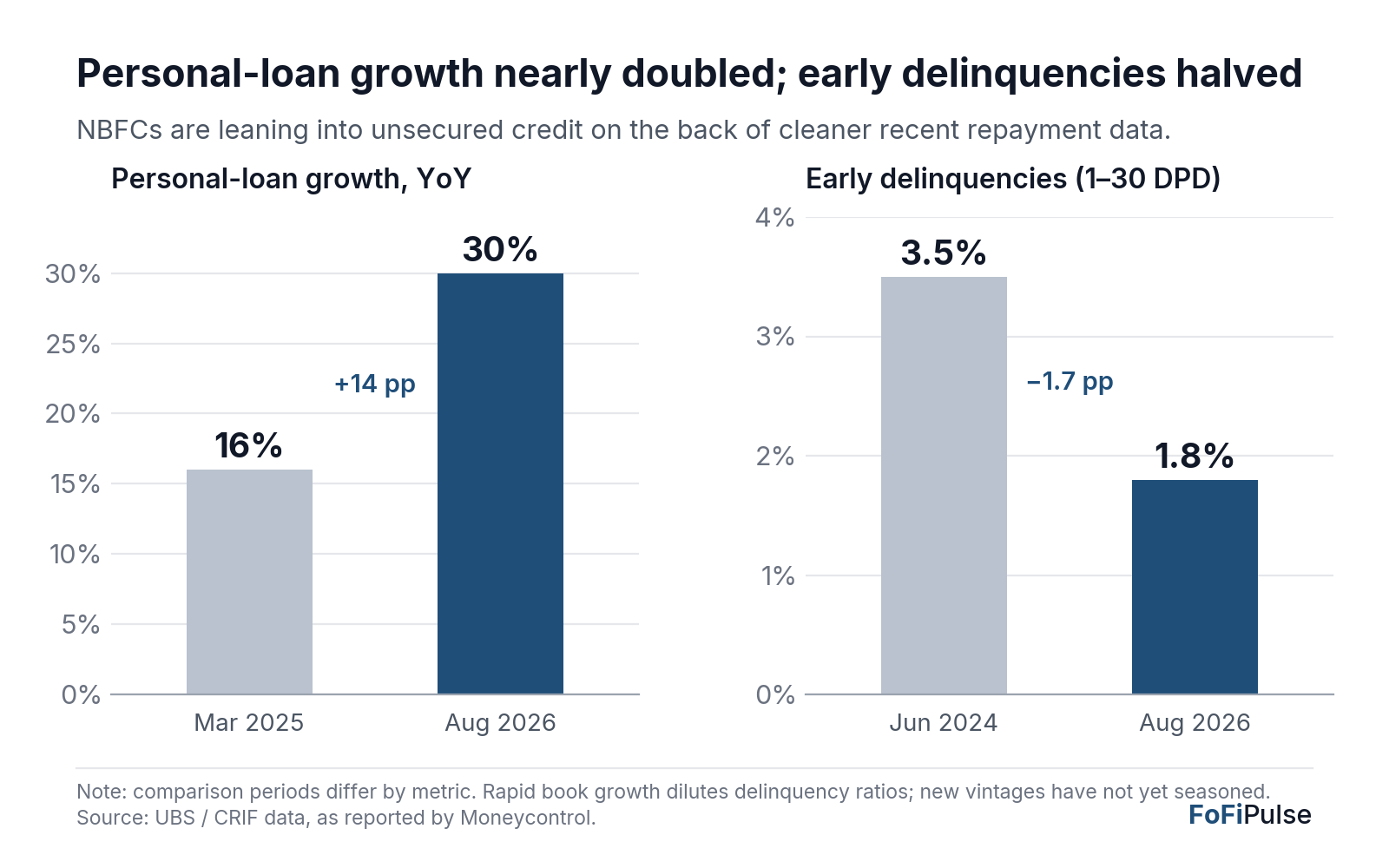
Source: UBS / CRIF data, as reported by Moneycontrol.
The trend extends beyond unsecured personal loans.
RBI’s July data show overall NBFC credit growing 14.9% year-on-year, compared with 10.6% a year earlier. Retail lending grew substantially faster at 21.4%, versus 13.7% in the comparable period a year earlier.
Figure 03
NBFC credit growth is accelerating — retail is growing faster still

Source: RBI sectoral deployment of credit by NBFCs, July 2026.
And lender commentary points in the same direction.
After discussions with nine NBFCs at its India Forum, Jefferies reported healthy demand across vehicle finance, consumer lending, MSME credit and other segments, alongside broadly resilient asset quality through the September quarter.
None of these datapoints alone establishes that India is entering an indiscriminate credit boom.
Together, however, they point to a meaningful change in conditions:
funding is easier, recent asset quality is healthier, loan demand remains strong and lender risk appetite appears to be returning.
That is where RBI’s warning becomes important
The Economic Times reported this week that RBI cautioned senior bankers against allowing the liquidity surplus to trigger a loan “price war.”
According to the report, the concern discussed with bankers was straightforward: when lenders have large amounts of money to deploy, competition can push them towards lower pricing and progressively weaker parts of the credit spectrum in search of yield.
The resulting stress may not become visible immediately.
It often appears several quarters — or several years — after the original underwriting decision.
The reported conversation was not an RBI circular or public policy statement. But it is consistent with what the central bank has already been saying publicly.
At the NBFC and HFC Summit earlier this month, RBI Deputy Governor Shirish Chandra Murmu said that as credit growth accelerates, so does the risk to asset quality.
His message was explicit:
“Growth must never come at the cost of underwriting standards.”
RBI called for rigorous stress testing, early-warning systems and dynamic provisioning as lenders enter what it described as a new phase of growth.
That warning is particularly relevant when liquidity and competitive pressure move in the same direction.
Cheap funding by itself does not create bad loans.
Neither does rapid credit growth.
The risk arises when institutions respond to excess funding by simultaneously cutting price, expanding approval rates and moving down the credit curve.
That combination can weaken the economics of lending in two ways: lenders are being paid less for each unit of risk while potentially taking more of it.
The paradox: RBI is draining liquidity even as lenders look for growth
There is another complication.
The system may be flush with funding, but RBI is simultaneously trying to prevent excess liquidity from overwhelming monetary-policy transmission.
From the ₹11.16 lakh crore peak, banking-system liquidity had already fallen more than 55% to ₹4.92 lakh crore by September 21.
RBI sold ₹75,000 crore of government bonds over the preceding week and planned another ₹25,000 crore sale. Banks had also parked around ₹3.4 lakh crore through reverse-repo operations, while foreign-exchange operations were absorbing additional rupee liquidity.
So lenders are entering an unusual environment.
Their structural funding position has improved sharply because of FCNR inflows.
Yet market rates may not remain benign.
Expectations of monetary tightening have risen, meaning banks and NBFCs could simultaneously face strong credit demand and increasing marginal funding costs.
Jefferies already sees that tension emerging among NBFCs: loan demand remains healthy, while potential rate increases could push up funding costs with a lag.
That makes loan pricing even more important.
Aggressively reducing spreads today to deploy liquidity could become considerably less attractive if liability costs rise later.
What matters now is not credit growth alone
Headline credit growth will be the easiest number to watch over the coming quarters.
It may not be the most informative one.
The more important signals will be how lenders achieve that growth.
Watch whether approval rates begin rising sharply. Whether spreads compress faster in personal loans, MSME lending and other competitive categories. Whether lenders move into smaller-ticket or weaker-score borrowers. Whether balance transfers and takeover loans become more aggressive. And eventually, whether early-delinquency indicators begin reversing after their recent improvement.
For now, conditions remain favourable: liquidity is abundant relative to recent history, asset quality is resilient and credit demand is healthy.
That is precisely why underwriting discipline matters.
The next phase of India’s credit cycle may not begin with rising delinquencies.
It may begin much earlier — in the price lenders are willing to accept for taking the next unit of risk.
Sources: Reserve Bank of India; Reuters; SBI Research; UBS / CRIF data as reported by Moneycontrol; RBI sectoral deployment of credit by NBFCs; Jefferies India Forum commentary; The Economic Times.
Chart data use the figures cited in the article. Replace each LIQUIDITY_FIGURE_X_URL_HERE placeholder with the corresponding PNG URL from WordPress Media before publishing.